
Verification and Testing: No Escaping Good Data Science
Last updated on 2026-09-16 | Edit this page
Overview
Questions
- Why is “the code runs and the score is high” not sufficient?
- Which inexpensive checks catch expensive mistakes?
- How do I review an agent’s work when the code runs?
- How can the agent help me reason about results, not only write code?
- How do I make checks run automatically so they are never skipped?
Objectives
- Apply established data science verification practices (know your data, compare to a source of truth, ask a colleague, reproduce) to agent-generated analyses.
- Review an agent’s diff by looking for decisions you did not make, and have the agent list its own assumptions.
- After each feature, have the agent propose and add tests, including edge cases, and run them before moving on.
- Define test-driven development and apply it to research code: write the data or result test first, then have the agent implement against it.
- Make verification automatic: tests in CI and a protected
main. - Use an agent to reason over saved results and figures, and leave evidence in the repository for it to read.
- Run quick checks (label shuffling, baselines, overlap and duplicate checks, seed variation) that expose broken evaluations.
- Detect a group-leakage bug in code that runs cleanly and scores well, and write the assertion that catches it.
What the research shows about checking
Checking agent output is the bottleneck, not producing it:
- Agents multiply code written far more than code shipped: 240% more commits but only 30% more releases across 500,000 GitHub developers (Demirer, Musolff & Yang, 2026). Not all of the additional code is good code, and the gains attenuate at the human review step.
- Pull requests wait about five times longer for a human review under heavy AI use, and 31% more are merged without one (Faros AI, two years of telemetry from 22,000 developers at 4,000 companies, 2026).
Faros AI’s explanation has two parts. There is more to read: average pull-request size is up 51% and files touched per pull request up 60%, and the median wait before anyone starts a review is up 157%. And it is harder to review once started: median time in review is up 441%, because AI-written code is superficially convincing (idiomatic, well named, stylistically consistent with its surroundings), so its failures are structural rather than obvious. Reviewers have to reconstruct what the code was meant to do instead of scanning for errors. In their phrase, the code arriving for review was never review-ready.
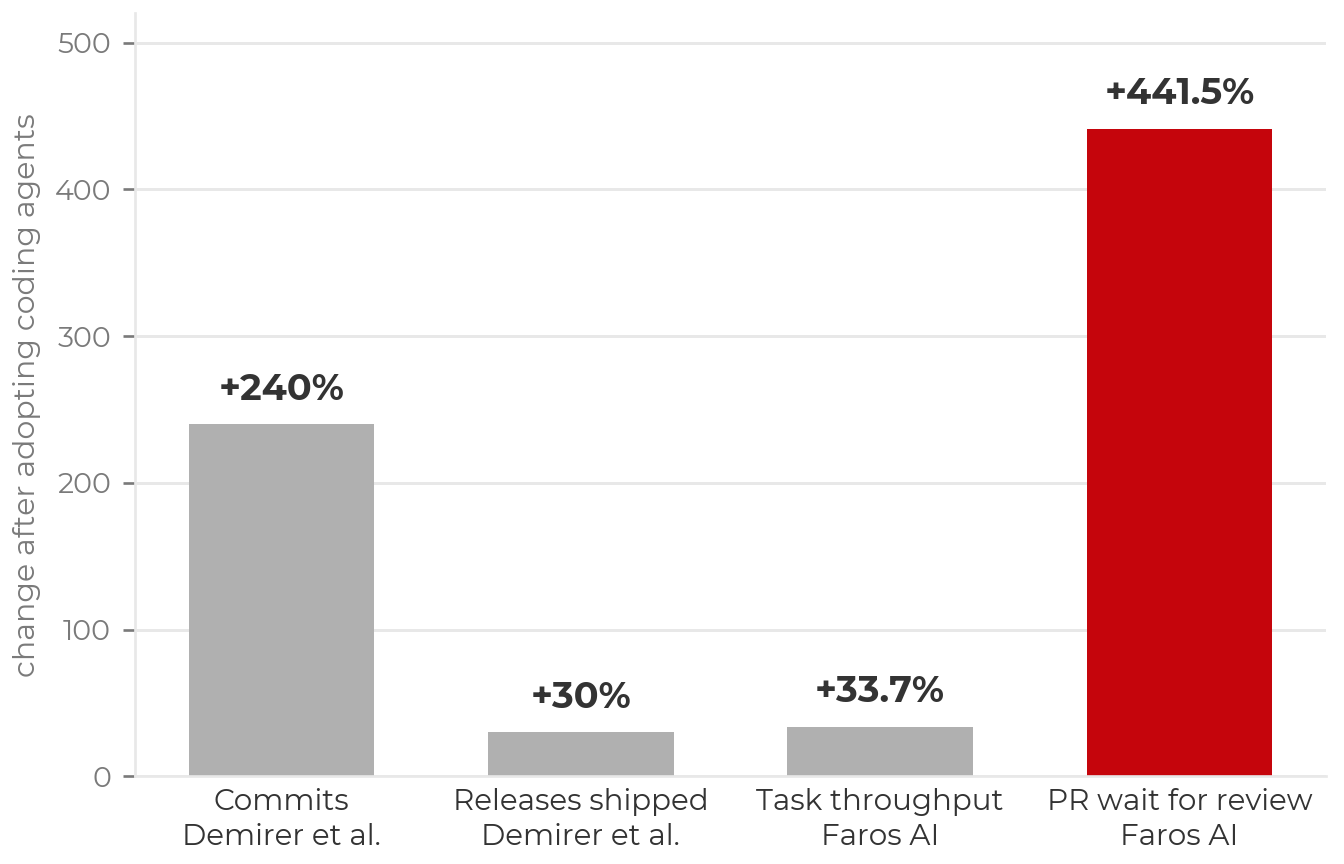
The skill this episode teaches is the one in short supply.
The pull request as the final human check
Every feature comes back as a pull request on a branch. That is the
git arrangement from the safety episode, and it is where verification
happens: nothing the agent did reaches main until a person
approves the diff. The pull-request review is the last control, applied
after all the others.
A review done by eye alone does not scale. Pull requests are 51% larger under heavy agent use, and the code reads cleanly while being wrong. The review therefore needs support: tests that run on every push and checks that fail loudly. That support is the subject of the rest of this episode.
Where the review happens: two postures
Agents work on branches, never on main, and someone
(you, a colleague, or CI) reads the code before it is merged. Within
those rules, two workable postures differ on when the human review
happens.
The pull request is the review gate. The agent
commits freely and often to its feature branch as it works. The commit
log becomes verbose; that is acceptable, because frequent small commits
are restore points, and an agent’s granular history is more useful than
the usual human sequence of wip, fix,
fix again. Your review happens once, on the full
pull-request diff, as it would for a human collaborator’s branch. This
posture maintains momentum and concentrates attention where it is most
effective. It depends on safety nets: a real test suite, CI checks
gating the merge, and diffs small enough to read in full.
Review every change as it happens. You approve each edit or commit, staying close to the work in real time. This is slower, and appropriate where the safety nets are absent: you are new to the tool, the code is sensitive, the tests are thin, or you are still establishing what the agent does with your codebase.
The choice is a calibration, and it maps onto the verification tiers
at the end of this episode. Throwaway and well-tested working code
tolerate the pull-request gate; load-bearing code with weak tests calls
for per-change review, or the gate with a second reviewer. Many people
use both: the gate for routine feature work, per-change review when
modifying anything expensive to get wrong. Record the choice in
CONTRIBUTING.md or the context file so the agent and your
collaborators both know it.
Reviewing in shared projects
Two situations change the rules slightly:
- Contributing to a project you do not own. Read the contribution guidelines first (“summarize CONTRIBUTING.md and any pull-request conventions in this repo” is a good first prompt), work from a fork when you lack write access so no agent has push access to the canonical repository, disclose AI assistance where the project requires it (The Carpentries has a Generative AI contributions policy, for example), and keep pull requests small. Maintainers review in their own time, and large diffs are a common reason contributions are declined.
- Maintaining a project others contribute to. Agents are useful for triaging issues, drafting release notes from the commit history, dependency updates, documentation sweeps, and a first-pass review of incoming pull requests (“what does this change, and what should a human examine most closely?”). The human retains the merge decision. An agent’s review is a brief for your judgment, and incoming pull requests are untrusted input: prompt injection through pull-request content is a documented pattern.
Look for decisions you did not make
A well-specified prompt still has unintended consequences. When reviewing agent-written analysis code you are not checking syntax; the code runs. You are looking for decisions. Do this before and after every feature: ask the agent for its assumptions, ask for tests and edge cases, run them and confirm the results look right, then move on. The places most likely to contain unexamined decisions:
-
Silently dropped or altered rows: a default
dropna(), an inner join that shrinks the table, a type coercion that turns errors into NaNs. Require row counts before and after every join and filter. - Defaults treated as decisions: imputation strategy, class weights, regularization strength, thresholds. Every default the agent accepted is now a choice you are responsible for. This is one reason to start with an MVP small enough that you can own every choice in it.
- Substituted metrics: you asked about accuracy and the report features F1 because the number was higher.
-
Suppressed problems: warnings silenced,
try/except: pass, an error “fixed” by deleting the check. An agent told to make the code run sometimes does exactly that.
Two prompts worth using at every review:
Summarize every choice you made that I did not specify, and flag the risky ones.
Propose tests for our latest feature, including edge cases.
The first surfaces the dropped-row and default-parameter decisions above more reliably than reading line by line.
Exercise 1: Test the feature you just built (10 minutes)
Start from feature 1, the one you implemented in the previous episode. This is the step that follows every feature, before the next one begins.
-
Ask for its assumptions and proposed tests, in plan mode:
Read
plan.mdand the feature 1 code you just wrote.- List every choice you made that I did not specify, and flag the risky ones.
- Propose tests for this feature to ensure robustness as we develop the full pipeline, including edge cases: empty input, wrong shape, duplicates, a sample that lands in both splits, etc. Say which tests matter most and why.
- Do not edit anything yet. After I review, implement the tests as an automated GitHub Action that will run on each push.
Do not edit anything yet.
Select the tests that matter. Let the agent propose more than you would; keep the ones that protect against a wrong result.
Have it add them and run
pytest. Fix what fails, then commit.Make it automatic. A GitHub Actions workflow can run
pyteston every push (GitHub Actions for Python); the prompt’s third step asks the agent to write it. Protectmainso that a failing check blocks the merge (about protected branches).
A methodological requirement that was previously implicit is now an
executable contract. The agent has a feedback loop that fails when it
reaches for the average-case pattern, and you have an artifact that
continues to protect the project on every future change, whether the
next edit comes from an agent, a colleague, or you in six months. With
CI and a protected main, the check cannot be forgotten.
One caution: an agent asked to “add tests” for existing code will often write tests that assert whatever the code currently does, which preserves bugs rather than catching them. That is why step 1 asks for assumptions and risks before asking for tests. You decide what must be true; the agent writes the repetitive parts; you review the tests with the same care as the implementation.
Test-driven development: write the test first
The tests in Exercise 1 were written after the code. That is the common order, and it has a known weakness: a test written after the fact tends to describe what the code does, not what it should do, so it preserves whatever the agent decided. Test-driven development (TDD) reverses the order. You write a test that states the required behavior, watch it fail, and only then write (or have the agent write) the code that makes it pass. The test is the specification, and the code is judged against it rather than the other way round.
With an agent, this order has a second benefit. A test the agent must
make pass is an executable feedback loop: the agent runs it, reads the
failure, and revises, without you as the only check. The prompt becomes
“make pytest tests/test_feature2.py pass” instead of a
paragraph of prose, and the acceptance criterion cannot drift.
The alternative for the next feature, then, is: before prompting, write one test that encodes what “correct” means for this step, commit it, and ask the agent to implement against it. You decide what must be true; the agent does the work of satisfying it.
For research code, the tests worth writing first are rarely about function signatures. They are about the data and the result: the row count and class balance you expect, a hand-checked subset the pipeline must reproduce, a metric that must be stable across seeds, a split that must not leak. Those are the tests in the next section, and they are this lesson’s form of test-driven development.
Agents speed up the code; good data science practice still applies
Research computing already had an answer to “how do I know this analysis is correct?” before AI tools existed:
- Know your data. Distributions, outliers, units, missingness, class balance. Look at the rows.
- Compare to a source of truth. A published baseline, a hand-computed subset, a control.
- Know what your model is responding to. If the strongest predictor makes no scientific sense, that is a finding about the pipeline, not about the phenomenon.
- Reproduce the result. Rerun it, change the seed, rerun on a fresh split. If it does not hold, something you are not controlling is driving it.
- Plot the results and review them. Agents can sometimes help, but expert eyes are often needed.
None of this has changed. What has changed is speed: a plausible, clean-running, well-scoring analysis can now be produced in minutes, which means you can be misled in minutes as well. The checking has to keep pace.
Tests for good data science practice
Each of the practices above can be written as a test the agent implements and CI runs. Written before the feature they protect, they are test-driven development for research code. Prompts to start from:
- Know your data. Write a test that loads the raw data and asserts the row count, class balance and missing-value rate we expect. Print the majority-class baseline next to our metric.
-
Compare to a source of truth. Add a test that
runs our pipeline on the 20 rows in
hand_checked.csvand asserts every output matches the values I computed by hand. - Reproduce the result. Write a test that trains twice with different seeds on a fresh split and asserts the metric moves less than 2 points. If it moves more, the result is noise.
- Know what your model is telling you. Write a test that fails if any of the top five predictors is an ID column, a timestamp, or anything derived from the label.
- No leakage. Assert no subject, image, page or source document is in both splits, and no duplicate rows either. Then shuffle the labels and retrain. If the score does not collapse to chance, something leaks.
Agents as data scientists
Verification is not only about finding bugs. The agent is also a fast second reader of your results, if it is given something to read.
- Ask it to reason over results, not only to write code. What stands out, what disagrees, what to try next.
-
Leave evidence in the repository. Metrics files,
metadata, figures, run logs, a
results.md. What is not written down does not exist for the agent. - It can also read plots. A saved figure is context.
- Direct it to the evidence each time. It does not remember the previous session and will not open a file you did not name.
- It does not replace your own reading. Check every number it cites against the file. It sees a portion of the project, never all of it.
Read
results/feature1_metrics.json,figures/cv_by_fold.pngandplan.md. What stands out? Which fold or class is driving the average, and does the plot agree with the numbers? Propose the one experiment you would run next and say what result would change our plan. Do not run anything yet.
Exercise 2 (optional): What is wrong with this? (5 minutes)
The no-leakage test above is the general form of a common failure. This exercise shows the specific case.
PYTHON
# Brain decoding. 20 subjects, 400 trials each,
# one EEG window per trial.
X, y, subject = load_windows()      # X: (8000, ch, t)

X_train, X_test, y_train, y_test = train_test_split(
    X, y, test_size=0.2, random_state=42)

clf = make_pipeline(StandardScaler(), LogisticRegression())
clf.fit(X_train.reshape(len(X_train), -1), y_train)
print("accuracy", clf.score(
    X_test.reshape(len(X_test), -1), y_test))
# accuracy 0.91
The code runs. The number is high. Find the bug. Then write the one assertion that would have caught it.
Every subject appears in both splits. The model learned to identify each person, not what they were looking at. On a new subject the score drops:
PYTHON
X, y, subject = load_windows()   # subject: one ID per trial
from sklearn.model_selection import GroupShuffleSplit

train_idx, test_idx = next(GroupShuffleSplit(
    test_size=0.2, random_state=42).split(X, y, groups=subject))
assert set(subject[train_idx]).isdisjoint(subject[test_idx])
# accuracy on unseen subjects: 0.58
Split by the unit that repeats, and assert it: subject in a brain-decoding study, camera burst in a wildlife-camera dataset, page in a document-transcription task, source document in a retrieval pipeline. The assertion runs every time, so it is never forgotten. Checks that must be remembered are eventually skipped.
If you did not find it, that is the usual outcome. Nothing in this
code looks wrong, no error is raised, and the score rewards not looking
further. This is the plausible-average-case failure from the previous
episode: train_test_split is the pattern in a million
notebooks, and the agent optimized for apparent completion, a clean run
and a high score. If your review consists of “does it run, is the score
good”, you and the agent have the same blind spot.
Autonomy is purchased with verification
The highest-leverage practice in agentic coding is to make verification executable. Agents perform markedly better when they can check their own output by running tests, comparing against known values, and validating properties, rather than relying on you as the only feedback loop. Include test cases in the prompt. Point at symptoms rather than fixes (“fix the root cause and verify; do not suppress the error”). For analyses, require printed evidence. Tests are now inexpensive to write: ask for them with every feature, ask for data-validation tests on the actual dataset (expected columns, value ranges, unique identifiers, row counts across merges), and ask the agent what inputs would break its own function.
The more trustworthy the checks, the more autonomy can safely be granted. Scale the checking to the stakes, and choose the tier explicitly before starting:
| Tier | Example | Minimum verification |
|---|---|---|
| Throwaway | one-off plot, scratch script | Read the diff; inspect the output |
| Working code | lab-internal pipeline, reusable utilities | Tests pass in CI; you review the diff; data-property checks printed |
| Load-bearing | results in a paper, shared package, anything cited | All of the above, plus comparison to a source of truth and a second reviewer |
- Checking is the bottleneck. Agents multiply commits far more than releases, pull requests are larger and harder to review, and unreviewed merges increase. Verification is the scarce skill.
- The pull request is the final human check. Review by eye alone does not scale, so it needs tests on every push and checks that fail loudly.
- Established practice still applies: know your data, compare to a source of truth, know what your model responds to, reproduce the result, plot and review.
- Test-driven development reverses the usual order: write the test that states the required behavior first, then have the agent make it pass. The test is the specification.
- For research code, the tests to write first are about the data and the result: data expectations, a hand-checked subset, seed stability, sensible top predictors, no leakage. Each can be a test the agent writes and CI runs.
- Split by the unit that repeats, and assert it. A clean-running 0.91 can be 0.58 on unseen subjects.
- After every feature, before the next: have the agent list its assumptions, propose tests and edge cases, add them, and run them. Then commit.
- Make verification automatic: tests in CI and a protected
main. Autonomy is purchased with verification. - Choose a review posture deliberately: the pull request as the gate (the agent commits freely; one full review of the diff) when tests and CI support it; per-change review when they do not. Incoming pull requests on a shared project are untrusted input, and the human makes the merge decision.
- Leave evidence in the repository and direct the agent to it. It reads figures and metrics, but only those you name, and you check every number it cites.